


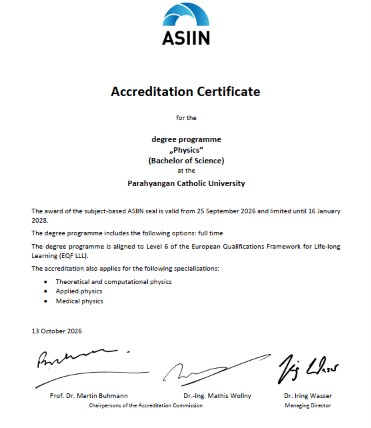
BANDUNG, UNPAR – The Undergraduate Physics Study Program at Parahyangan Catholic University (UNPAR) has achieved a significant milestone in advancing the quality of higher education by obtaining international accreditation from the Accreditation Agency for Degree Programs in Engineering, Informatics, the Natural Sciences and Mathematics (ASIIN). This achievement reinforces UNPAR Physics’ commitment to providing high-quality physics education that responds to developments in science and technology and aligns with internationally recognized quality standards.
International accreditation represents a strategic step for the UNPAR Physics Study Program in ensuring that its educational provision consistently meets internationally recognized quality standards. Through an external evaluation process, the quality of the study program is assessed across various aspects, including learning outcomes, curriculum design, teaching and learning processes, and the relevance of education to professional needs.
International Recognition of Quality Physics Education
ASIIN is a Germany-based accreditation agency specializing in quality assurance for degree programs in engineering, the natural sciences, mathematics, informatics, and related fields. Its accreditation process emphasizes the alignment of educational objectives, learning outcomes, graduate competencies, and the evolving needs of scientific development and the professional world.
For UNPAR Physics, this international accreditation represents important recognition of the program’s ongoing efforts to enhance its academic quality. It also provides a foundation for continuous evaluation and improvement, ensuring that students acquire the knowledge, skills, and competencies needed to meet contemporary challenges.
Developing Physics Competencies for the Needs of the Future
The Undergraduate Physics Study Program at UNPAR equips students with a strong foundation in physics, mathematical and computational skills, as well as communication and problem-solving abilities. Students also have opportunities to pursue their academic interests through specialized fields, including Medical Physics, Applied Physics and Instrumentation, and Theoretical Physics and Computation.
This educational approach enables students to connect fundamental physics concepts with their applications across various fields. Graduates of UNPAR Physics are expected to adapt to technological developments, pursue further studies at higher academic levels, and contribute to research, education, industry, and other professional fields.
International accreditation further encourages the study program to maintain alignment between its curriculum, academic activities, and developments in scientific knowledge. As a result, education focuses not only on theoretical understanding but also on developing the competencies required to address real-world challenges.
A Commitment to Continuous Quality Improvement
The achievement of ASIIN international accreditation further strengthens UNPAR Physics’ track record in maintaining educational quality. At the national level, the Undergraduate Physics Study Program at UNPAR has also maintained its Unggul (Excellent) accreditation status, awarded by the Independent Accreditation Agency for Natural Sciences and Formal Sciences (Lembaga Akreditasi Mandiri Sains Alam dan Ilmu Formal, or LAMSAMA). This accreditation is based on Decree No. 154/SK/LAMSAMA/Akred/S/VI/2025, valid from June 18, 2025, to June 17, 2030.
Together, these achievements reflect the study program’s ongoing efforts to strengthen its quality assurance system, enhance teaching and learning, and foster an academic environment that supports the development of both students and faculty members.
For UNPAR Physics, this recognition is not a final destination but rather a motivation to continue growing and innovating. Through the advancement of education, research, and academic collaboration, UNPAR Physics is committed to contributing to scientific and technological progress while preparing competent, adaptable graduates who can make a positive impact on society.