


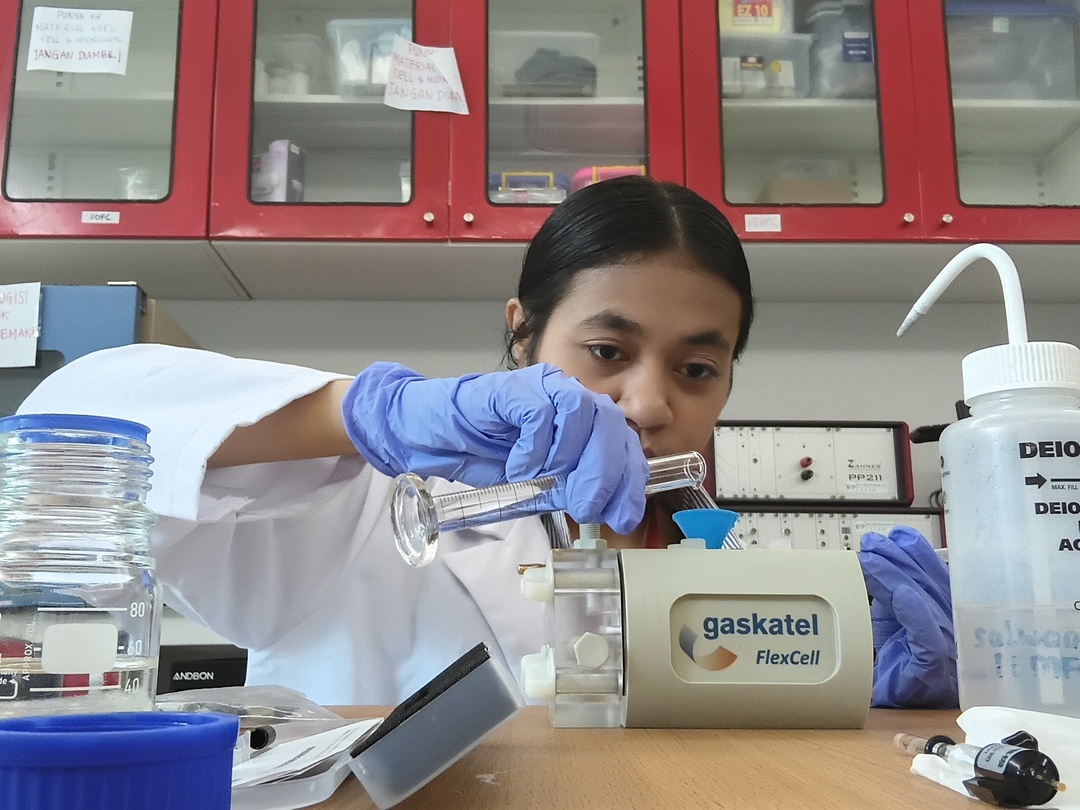
The Merdeka Belajar Kampus Merdeka (MBKM) program provides students with opportunities to gain learning experiences beyond the classroom, including direct involvement in research activities. One implementation of this program is a research internship at the National Research and Innovation Agency (BRIN), which offers hands-on experience within a professional research ecosystem.
During her participation in the MBKM program at BRIN, Maria C. Karenina, commonly known as Karen, a sixth-semester Physics student, served as a research assistant actively involved in various laboratory activities. Her responsibilities included preparing synthesis materials, fabricating and coating catalysts on the Gas Diffusion Layer (GDL), and performing drying processes using a vacuum oven. In addition, Karen conducted electrochemical testing using a potentiostat (PARSTAT) through several methods, such as Cyclic Voltammetry (CV), Linear Sweep Voltammetry (LSV), Electrochemical Impedance Spectroscopy (EIS), Chronoamperometry (CA), and galvanostatic testing.
The research activities were further supported by regular discussions with supervisors from BRIN as well as academic advisors from her home university. As an MBKM participant, Karen was also required to prepare periodic reports and maintain a research logbook as part of the documentation and evaluation of her activities.
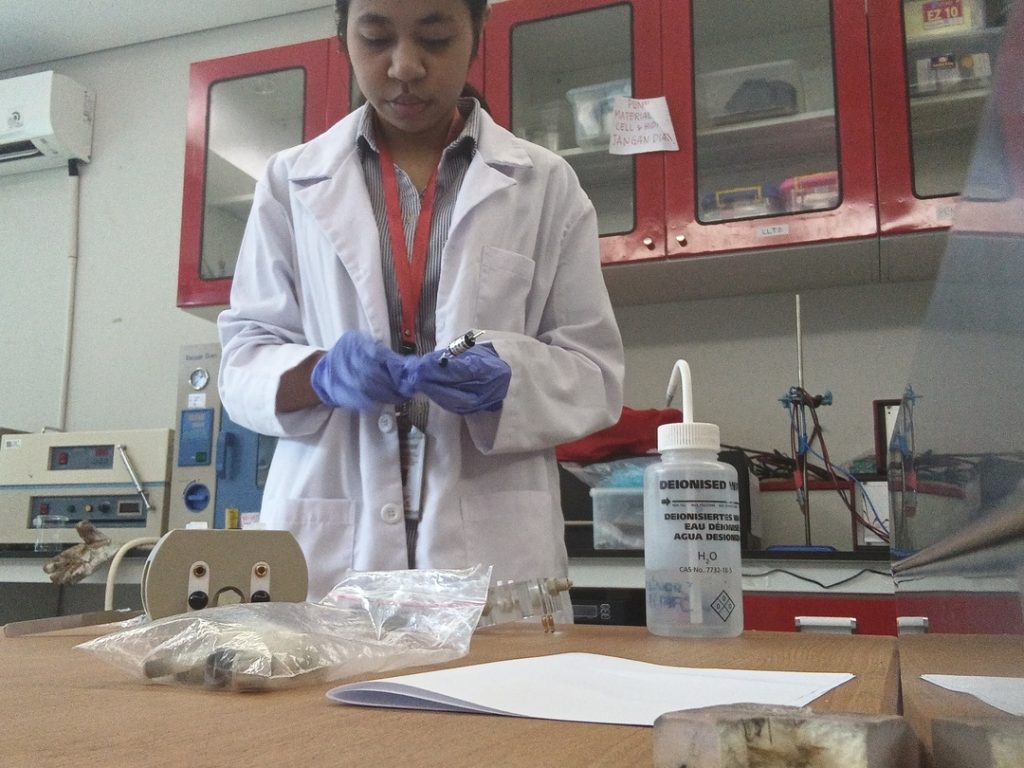
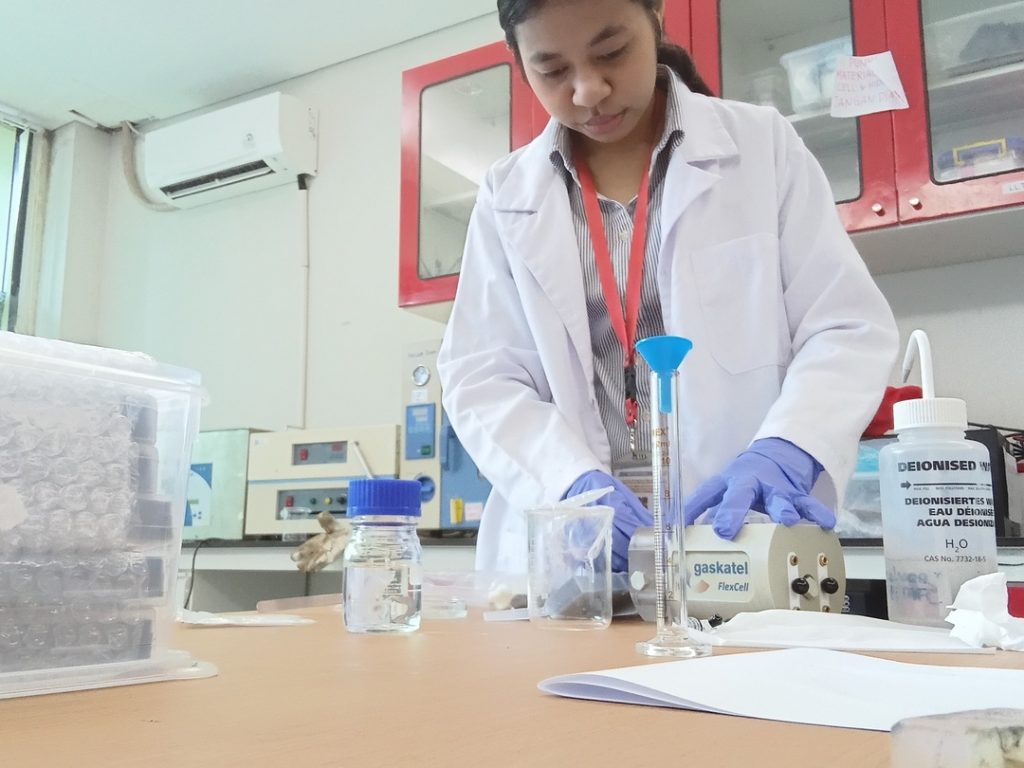
The research topic addressed in this program focuses on the development of nickel-based catalysts for the Oxygen Reduction Reaction (ORR) in fuel cell applications. The study aims to develop a more cost-effective catalyst material as an alternative to platinum-based catalysts while maintaining optimal performance. The primary focus includes enhancing catalytic activity, material stability, and reaction efficiency in alkaline electrolyte media, such as potassium hydroxide (KOH). The results of this research are expected to contribute to the advancement of sustainable and affordable clean energy technologies.
The methods employed in this research include the synthesis of nickel-based catalysts derived from battery waste, catalyst coating on GDL, and a series of electrochemical tests. The main equipment used consists of a potentiostat (PARSTAT), vacuum oven, analytical balance, micropipettes, and standard laboratory glassware. The learning process was carried out through a combination of direct supervision by researchers, literature studies of scientific journals, and intensive laboratory practice until the student was able to operate the instruments independently.
Throughout the program, Karen gained valuable experience, particularly in understanding systematic research processes, from experimental design to data analysis. The challenges encountered included the complexity of interpreting electrochemical data and technical issues during testing. However, these challenges were addressed through discussions with supervisors, literature review, and repeated experiments with improved control conditions.
The MBKM program also made a significant contribution to the development of students’ competencies, including Karen’s, both in technical and non-technical aspects. The technical skills developed include catalyst synthesis and characterization, as well as an understanding of ORR mechanisms. Meanwhile, the non-technical skills gained include time management, problem-solving, scientific communication, and independence in working within a research environment.
Overall, participation in the MBKM program at BRIN has had a positive impact on students’ readiness to engage in the professional research environment. This experience not only strengthens interest in the fields of materials research and renewable energy but also opens opportunities for pursuing higher education and contributing to future research developments.