


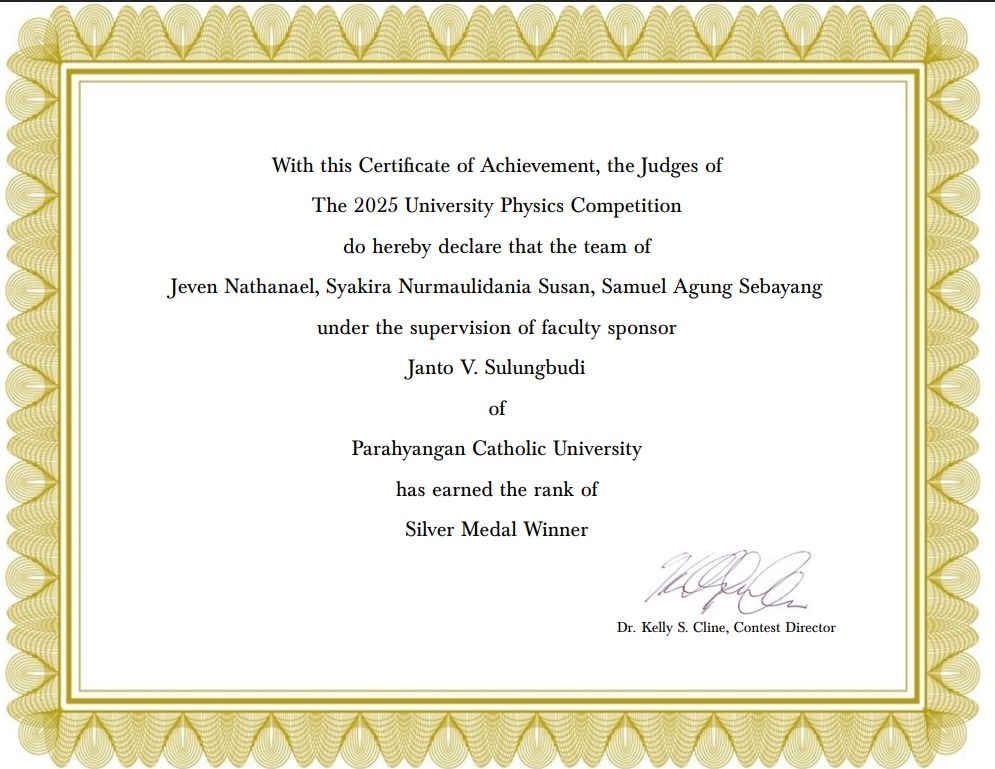
Bandung, January 17, 2026 — Students from the Physics Study Program of Parahyangan Catholic University (UNPAR) have once again achieved an international accomplishment. Two UNPAR Physics teams successfully earned Silver Medals at the 2025 University Physics Competition (UPC), a prestigious global physics contest participated in by undergraduate students from universities around the world.
The two award-winning teams are:
Team 1 (Supervisor: Mr. Janto V. Sulungbudi)
- Jeven Nathanel
- Syakira N. Susan
- Samuel Agung S.
Team 2 (Supervisor: Mr. Reinard Primulando)
- Vernando Nicky B.
- Maria C. Karenina H.
- Elroy Anderson L.
This achievement highlights the students’ strong analytical skills, academic excellence, and teamwork in addressing complex scientific challenges at the international level.



About the University Physics Competition (UPC)
The University Physics Competition is an annual international contest designed for undergraduate students. In this competition, teams of three students from each university work intensively for 48 consecutive hours to:
- Select one of two real-world physics problems,
- Conduct a theoretical analysis using fundamental physics principles,
- Perform independent research using books, journals, computers, the Internet, and self-developed programs,
- And produce a formal scientific paper in English detailing their methodology, analysis, and results.
The problems are intentionally open-ended and conceptually rich, often providing incomplete data. Therefore, students must develop reasonable assumptions, design appropriate models, and justify their approaches scientifically. The assessment of answers can be right or wrong depending on the type of problem model and various approaches that must be scientifically justified.
Teamwork Strategy During the 48 Hours
Within the limited timeframe, both teams implemented an effective division of tasks. Each member took on specific responsibilities, such as solving the physics problems, designing the paper structure, and writing and revising the manuscript.
However, their main key to success was consistent communication and cross-checking each other’s work to ensure both clarity and accuracy. In addition to working hard, the teams also maintained their physical condition by managing rest, meals, and sleep to stay focused throughout the competition.
This balanced approach allowed them to remain productive while maintaining the quality of their scientific analysis.
Jeven Nathanel’s Experience: From Nervousness to Pride
For Jeven Nathanel, a member of Team 1, winning the silver medal was both an emotional and academic milestone.
At the beginning, he admitted feeling nervous about participating in the competition. His previous experience and the fact that his teammates were not senior students made him worry that they might not produce a strong paper.
However, as the competition progressed, his anxiety gradually disappeared.
“Personally, I feel very happy to win the silver medal and make UNPAR and my parents proud. My teammates certainly feel the same way,” he shared.
According to Jeven, smooth communication among teammates created a comfortable working environment with minimal conflict. Although several sections of the paper were delayed until the final day and the team experienced a lack of sleep, they successfully completed and submitted their paper on time.
The biggest challenges were determining the most appropriate initial approach among many possible solutions and clearly explaining their ideas in English so that the judges could easily understand their analysis.
From this experience, he learned valuable lessons about time management and trust.
“The most valuable lesson is learning how to manage time and trust your teammates. Without good teamwork, it would be impossible to complete a scientific paper within 48 hours.”
The Role of Faculty Supervisors
Although the competition rules prohibit direct assistance during the contest, the role of faculty supervisors remains crucial. The supervisors provided preparation sessions, explained the competition rules, and ensured that the teams had adequate facilities and a conducive working environment.
This support helped students prepare both mentally and technically before entering the intense 48-hour challenge.
Inspiring Future Generations
The success of these two UNPAR Physics teams in earning silver medals at UPC 2025 demonstrates that Indonesian students are fully capable of competing on the global stage through strong analytical thinking, scientific creativity, and solid collaboration.
This achievement is expected to inspire other students to take on international challenges and continue developing their competencies in physics. Congratulations to all team members and supervisors for this outstanding accomplishment. May this success become a stepping stone toward even greater achievements in the future.