


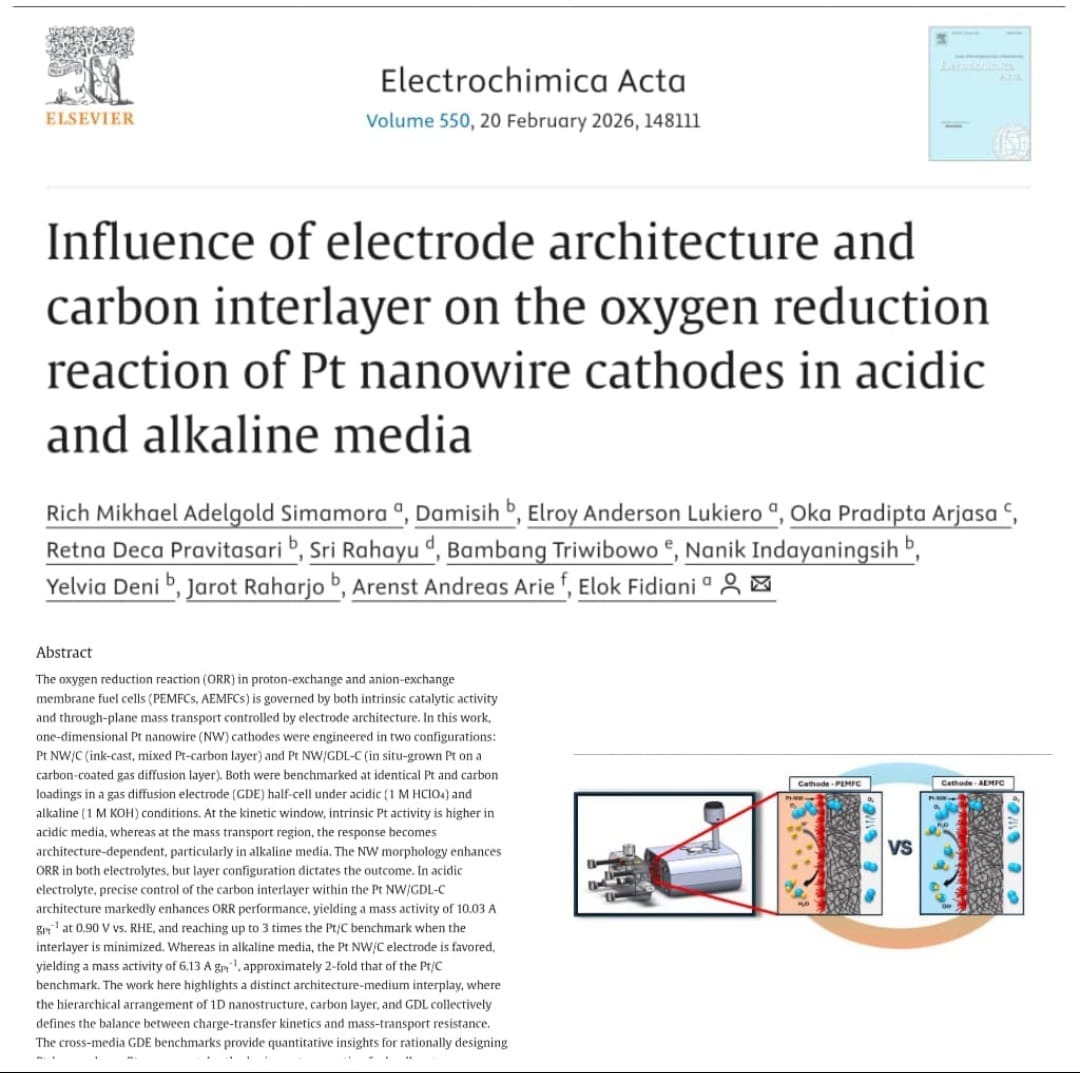
The development of clean energy technologies has become a major focus of global research in addressing the challenges of the energy crisis and climate change. One of the most promising technologies is the fuel cell, particularly the Proton Exchange Membrane Fuel Cell (PEMFC) and the Anion Exchange Membrane Fuel Cell (AEMFC), which are well known for their high efficiency and low emissions. In this context, Elroy and Rich have achieved a significant milestone through a research study that was successfully published in a Q1-ranked international journal published by Elsevier.
This publication marks Elroy’s first Q1 international paper and Rich’s second Q1 international paper. Rich is an alumnus of the Physics Study Program at Universitas Katolik Parahyangan (UNPAR). This achievement highlights the sustained contribution of the UNPAR academic community both current students and alumni to the international research arena.
In this article, the first author played a central role in the conceptual design and writing of the manuscript, development of the research methodology, preparation of data and figure visualizations, direct experimental investigation, analysis and interpretation of the results, and comprehensive organization of the scientific data presented in the paper.
The research was conducted at two main institutions: the Chemical Engineering Laboratory of Parahyangan Catholic University (UNPAR), where catalyst synthesis was carried out, and the National Research and Innovation Agency (BRIN), KST B.J. Habibie, Serpong, where electrochemical performance testing was performed. The entire research process spanned more than one year, reflecting a strong commitment to producing high-quality international scientific publications.

Research Focus: Optimization of the Oxygen Reduction Reaction
The paper, entitled “Influence of electrode architecture and carbon interlayer on the oxygen reduction reaction of Pt nanowire cathodes in acidic and alkaline media,” focuses on the investigation of the oxygen reduction reaction (ORR) at the fuel cell cathode. ORR is the kinetically slowest reaction and represents the primary performance-limiting step in fuel cell systems, both in PEMFCs (acidic media) and AEMFCs (alkaline media).
This study investigates platinum (Pt) catalysts with a nanowire (NW) structure, combined with carbon as a support material. Two different electrode architectures were developed: Pt NW/C, in which Pt nanowires are grown on carbon powder and subsequently deposited onto a gas diffusion layer (GDL), and Pt NW/GDL-C, in which carbon is first deposited onto the GDL, followed by in situ growth of Pt nanowires on the carbon-coated surface. Both configurations were benchmarked against a commercial Pt/C catalyst.
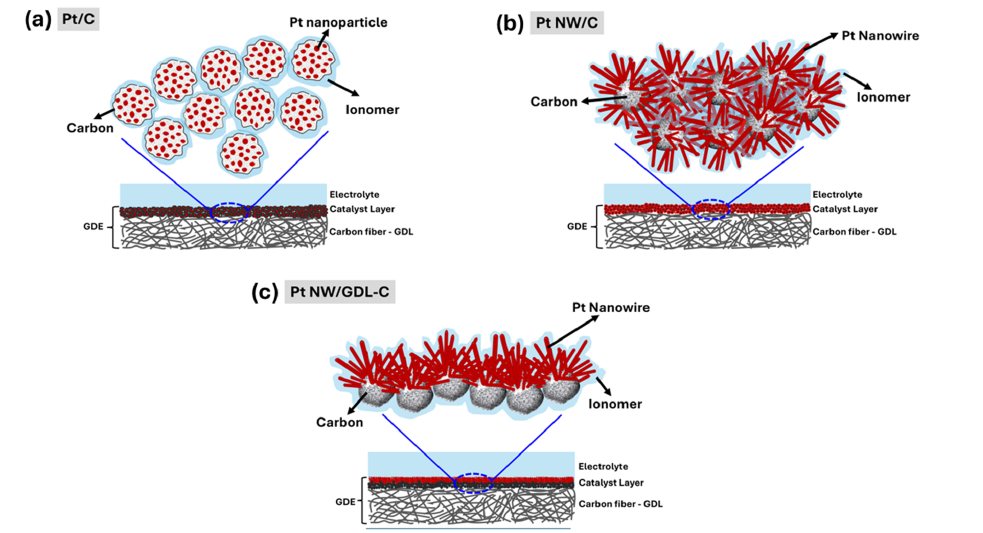
The results demonstrate that electrode architecture and carbon interlayer configuration have a significant impact on ORR performance, particularly when applied in different electrolyte environments. Under alkaline conditions, the Pt NW/C configuration exhibits superior performance, whereas under acidic conditions, Pt NW/GDL-C delivers the best results. PtNW/GDL-C achieves approximately three times the performance of Pt/C in acidic media, while PtNW/C exhibits nearly twice the performance of Pt/C in alkaline media.
Scientific Contributions and Technological Implications
These findings provide an important contribution to the development of fuel cell cathode design. In addition to confirming the advantages of Pt nanowire morphology in enhancing intrinsic activity and catalyst durability, the study demonstrates that electrode architecture directly influences mass transport, electron and ion percolation, and the distribution of oxygen and water within the electrode structure.
Furthermore, the results serve as a foundation for formulating design guidelines for cathodes tailored specifically to PEMFC and AEMFC systems, while also opening opportunities for the development of low-Pt or even PGM-free (Platinum Group Metals) electrodes through the optimization of carbon interlayers and electrode architectures.
Role of Supervision and Research Collaboration
The success of this research cannot be separated from the role of Elok Fidiani, Ph.D, as the academic supervisor, who consistently provided guidance from the early stages of idea formulation and methodology development to data analysis and the derivation of scientific conclusions. Her intensive and systematic mentorship formed a strong foundation for maintaining both research quality and publication standards.
In addition, collaboration with researchers at BRIN played a crucial role in ensuring the smooth execution of experiments, data acquisition, and experimental innovation throughout the research process. This synergy between a university and a national research institution demonstrates the strength of a collaborative research ecosystem in supporting internationally reputable publications.
Research Experience and Inspiration for Students
For Elroy and Rich, this research represents a valuable opportunity to engage directly in professional research environments. Adapting to new laboratory settings, different working systems, and experimental challenges that do not always align with theoretical expectations became essential parts of the learning process. These experiences fostered strong problem-solving skills, long-term research planning abilities, and mental resilience in navigating the dynamics of scientific research.
Through this achievement, Elroy and Rich hope to inspire other students and alumni to pursue research and scientific publication without hesitation. With strong curiosity, perseverance, and the courage to step outside one’s comfort zone, research can serve not only as an academic endeavor but also as a tangible contribution to technological advancement and a more sustainable energy future.